
Designing a Multi-Component Smart System for Parkinson's Screening
Parkinson's disease is a debilitating neurological condition that affects approximately 1% of individuals over the age of 60. Early/intelligent screening of this disease can have a significant impact on its diagnosis and treatment. It also improves the preparedness of patients and their families, both emotionally and financially, in facing this disease. Our focus in this project is on identifying the early signs of the disease so that we can provide early/intelligent screening using common tools, such as smartphones, and machine learning. Specifically, we are focusing on vocal components, emotion in voice, emotion recognition, emotion expression, facial movements, and the use of self-reports. Previous research has shown that patients with Parkinson's may have speech problems such as difficulty in choosing words, monotonous tone, difficulty in recognizing emotions, and difficulty in expressing emotions at the early stages of the disease. These patients may also have difficulty in expressing facial expressions. Alongside using technology to diagnose these issues, common questions for diagnosing Parkinson's disease will also be employed in this system to better facilitate screening. In other words, we are interested in using various modes to assess the disease to improve the accuracy of screening.
Methods division:
- Reviewing all reported symptoms that can be measured by public systems
- Collecting labeled data from patients
- Designing, training, and employing suitable machine learning methods for intelligent screening of this disease
Initially working with patients who have been definitively diagnosed, then attempting to test on individuals suspected of having the condition. Meanwhile, we will try to collect data over time to be able to conduct a longitudinal study on the components that can facilitate early screening in the future.
Disease Diagnosis Application:
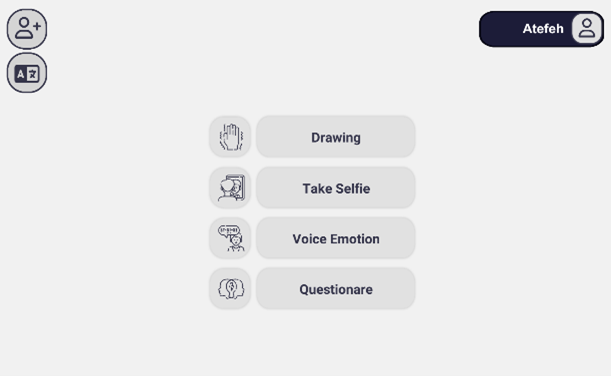
This software, designed and produced from the beginning of the research, aims to collect data for research and ultimately to serve as a diagnostic and assessment tool. The different sections of this software include:
Drawing: Here, the individual must draw shapes similar to those provided. These shapes include a spiral, wire, and other shapes whose drawing may be affected by Parkinson's. Drawing some shapes with both hands is requested to examine the disease's effect on each side of the body.
Clinical Data Recording: Information related to the patient, including medical history, medications, and other symptoms the patient may suffer from, is recorded. This section includes twenty questions designed with a specialist's consultation.
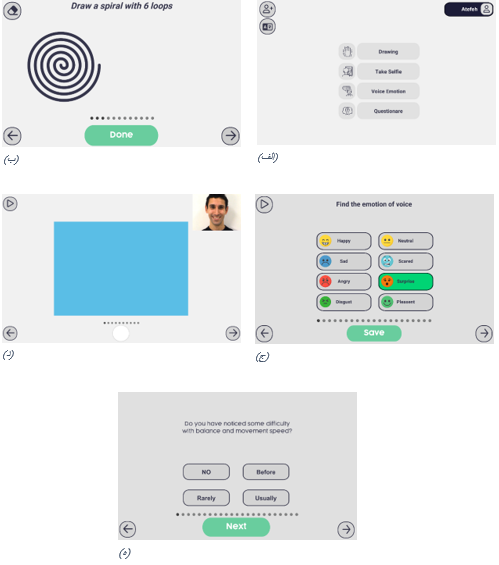
Emotion Expression: In this exercise, the individual must mimic an expression shown to them on their face and take a picture of themselves. These emotions include primary feelings such as laughter, sadness, disgust, and anger. During the execution, the individual is filmed to screen based on the timing of emotion expression, blinking, and the manner and intensity of emotion expression.
Emotion Recognition from Voice: In this section, 21 sounds of different emotions are selected to be played for the individual sequentially, and the test-taker is asked to describe the feeling of each sound.
Sound Game: Alongside the application, a game for data collection has been designed and produced. This adventure-style game moves the game character with the use of sound. The game character is a bird, and its altitude changes with the loudness of the sound. Inspired by the popular game Scream Go Hero, this game uses both sound and excitement for the person, allowing for the search for several Parkinson's symptoms by monitoring voice, emotions, and facial changes. Using the game and recording voice and emotions unconsciously is innovative, as in similar works, voice and emotions were usually expressed consciously.
Members: Atefeh Irani, Dr. Hadi Moradi, Dr. Rashad Hosseini, Dr. Maryam Mirian, Dr. Martin McKeown, Dr. Alireza Bahramian, Maryam Dadkhah, Saeed Marouf, Yasmin Haqbin
Collaborating Centers: Parkinson's Research Center – Pacific Parkinson Research Center (UBC University, Canada)
Reated Papers: